
There is a big difference between a cute crochet pet hat and a comfortable one. The crown may look perfect in a photograph, but the openings still need to leave room for the ears, the brim must stay away from the eyes and the pet has to remain relaxed while it is being worn.
This collection brings together ten realistic crochet pet hat ideas for dogs and cats, from a simple oatmeal ribbed beanie to a charcoal cat hat with a clean sage edge. Each design has its own free printable pattern guide, but the stitch counts are written as measured, adjustable instructions because every pet’s head, ears and coat are different.
Important: These hats are brief, supervised photo accessories, not everyday clothing or safety equipment. Remove the hat immediately if a pet freezes, paws at it, pants, hides, shakes its head repeatedly or tries to escape. Never use chin cords, throat elastic, wire, beads, bells, pom-poms or loose decorations.
How to Choose a Comfortable Crochet Pet Hat
Start with measurements, not a breed label. Wrap a soft tape around the head where the hat will sit, usually just above the eyes and behind the ears. Then measure from the center of one ear to the center of the other, the widest part of each ear and the depth from the crown to the finished front edge. Write those numbers down before you crochet.
| Measurement | Where to measure | Why it matters |
|---|---|---|
| Head circumference | Around the head above the eyes and behind the ears | Sets the finished hat size |
| Ear spacing | Center of one ear to center of the other | Positions the two openings |
| Opening size | Widest ear measurement plus comfortable clearance | Prevents rubbing and compression |
| Front depth | Crown to the edge above the eyes | Protects sight and blinking |
Use smooth washable yarn with a stable fabric. Avoid fuzzy novelty yarn, long loops and anything that can catch on a claw. Before fitting, stretch the hat gently, inspect every opening and weave in every tail.
1. Warm Oatmeal Ribbed Ear-Opening Hat
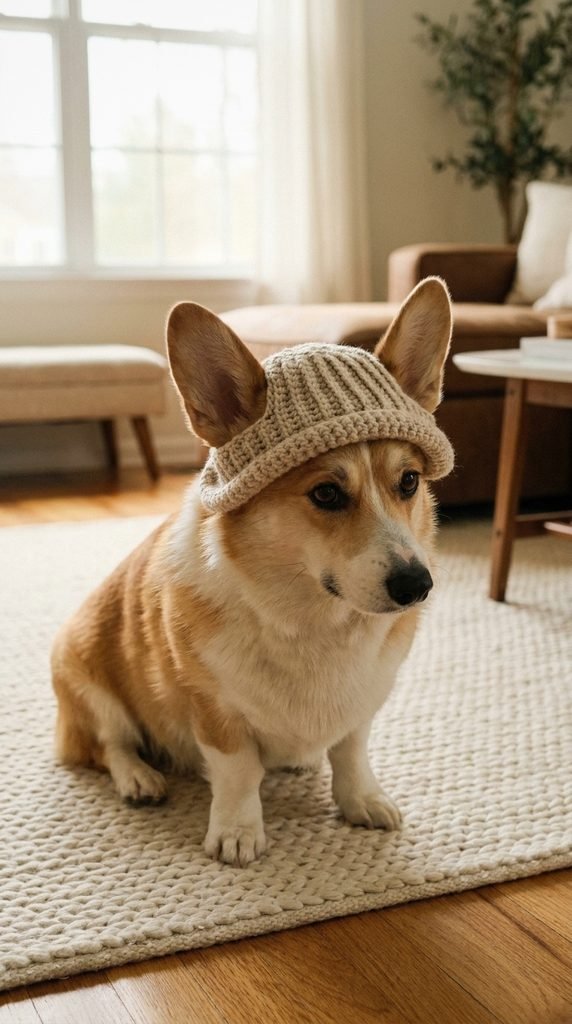
This is the best place to begin because the shape is uncomplicated and the ear openings are easy to see. The oatmeal yarn, soft brim and upright Corgi ears make the hat feel cozy without turning it into a costume.
Use this as the featured pattern anchor. A round crown, vertical-looking rib texture and a plain finished edge give you fewer details to troubleshoot while you learn how your pet’s head shape affects the fit.
Pattern direction
Build a measured round crown, switch to alternating raised ribs for the body, then create two marked openings at the ear line. Finish with one soft single-crochet edge. The brim should stop above the eyes, not sit over the eyebrows.
Fit note
The supplied photograph is a good visual reference, but do not copy its apparent size. Measure head circumference, distance between ear centers and the widest part of each ear before choosing stitch counts.
Best stitch direction: Single crochet crown, alternating front-post and back-post half-double-crochet ribs, single-crochet edge.
2. Sage Everyday Cotton Pet Hat
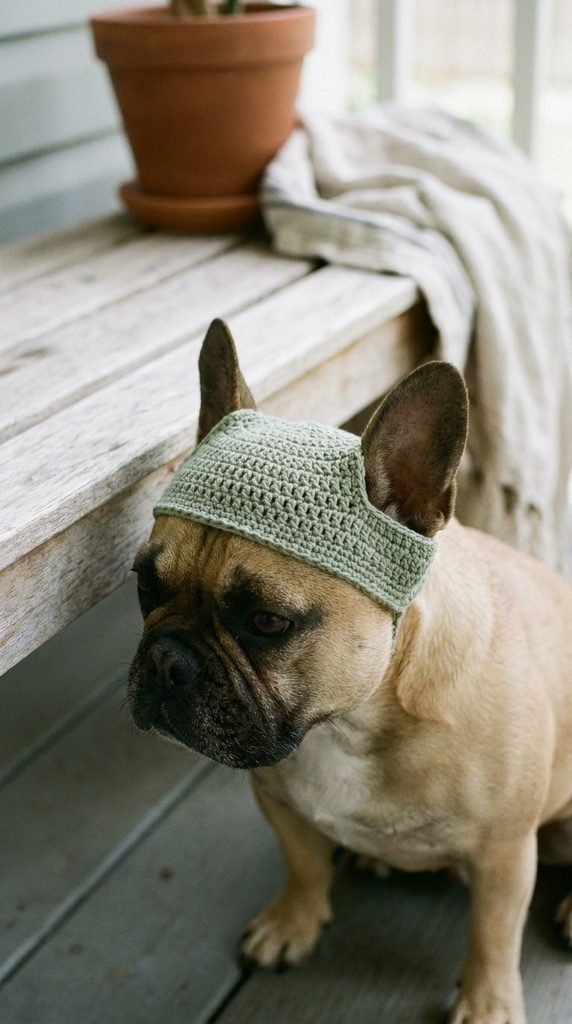
A simple sage cap is useful when you want the pet, not the accessory, to carry the image. There is no bulky trim and no decoration to snag, so the stitch texture and clean openings do the work.
This is the most adaptable version for a beginner. Dense single crochet creates a stable fabric that is easy to measure, easy to wash and easy to inspect for stretched loops.
Pattern direction
Work a smooth round crown in single crochet, pause at the ear line for two measured openings and add one narrow edging round. Keep the forehead edge low enough to frame the eyes without touching them.
Fit note
French Bulldogs have broad heads and upright ears, so a generic small-dog size is unreliable. Measure around the widest head area and check that the openings do not pull the hat toward the eyes.
Best stitch direction: Single crochet in rounds with compact single crochet around each ear opening.
3. Terracotta and Cream Striped Pet Hat
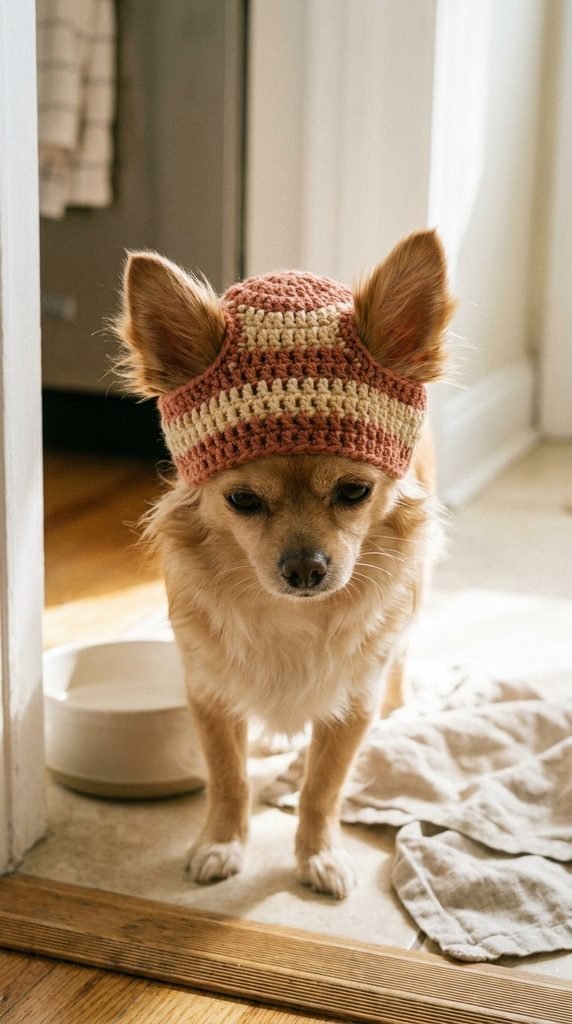
Terracotta and cream are a natural pairing for a small dog with a warm coat. The stripes add personality, but the basic shape remains a practical ear-opening cap rather than a novelty costume.
Horizontal color changes are easier to control than a complicated chart. They also make it simple to adjust the hat depth: add or remove complete rounds while keeping the stripe rhythm intact.
Pattern direction
Work the crown and body in half-double crochet, changing color every two or three rounds. Form both ear openings in the same round, then continue the next round over the chain spaces and reinforce their edges.
Fit note
The photographed brim is generous. Make sure the real finished brim sits above the eyes when the dog lowers its head. Shorten the brim if it casts over the eye line.
Best stitch direction: Half-double crochet in rounds, color changes at the side, single crochet around openings and edge.
4. Navy Foldover-Cuff Pet Hat
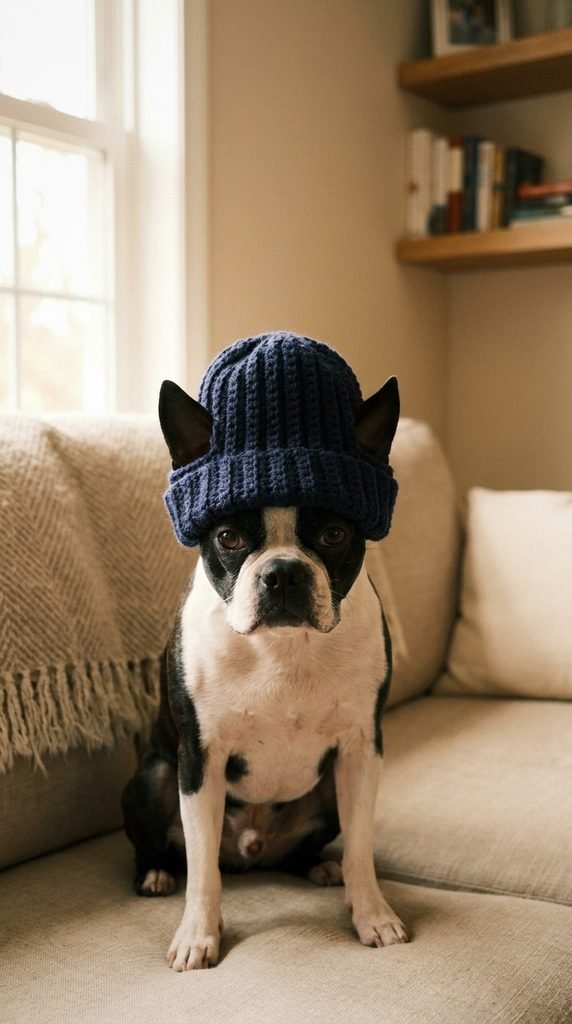
The navy version has the look of a tiny winter beanie, with a cuff that adds structure around the forehead. It is a strong photograph, but the cuff needs a careful fit check because a deep fold can drift downward.
A ribbed cuff can hide a slightly uneven edge and gives the hat a more finished silhouette. It is best for a pet that tolerates a brief fitting calmly, not for a hat that will be worn for hours.
Pattern direction
Work a round crown and ribbed body, then add a short foldover cuff in alternating post stitches. Keep the ear openings in the crown and check that the folded cuff cannot cover the eyes.
Fit note
Boston Terrier ears are upright and easy to mark, but the wide cuff can still rotate. Test the hat while the dog looks down, turns its head and blinks naturally.
Best stitch direction: Single crochet crown, raised rib body, short front-post/back-post foldover cuff.
5. Blush Scalloped-Edge Pet Hat
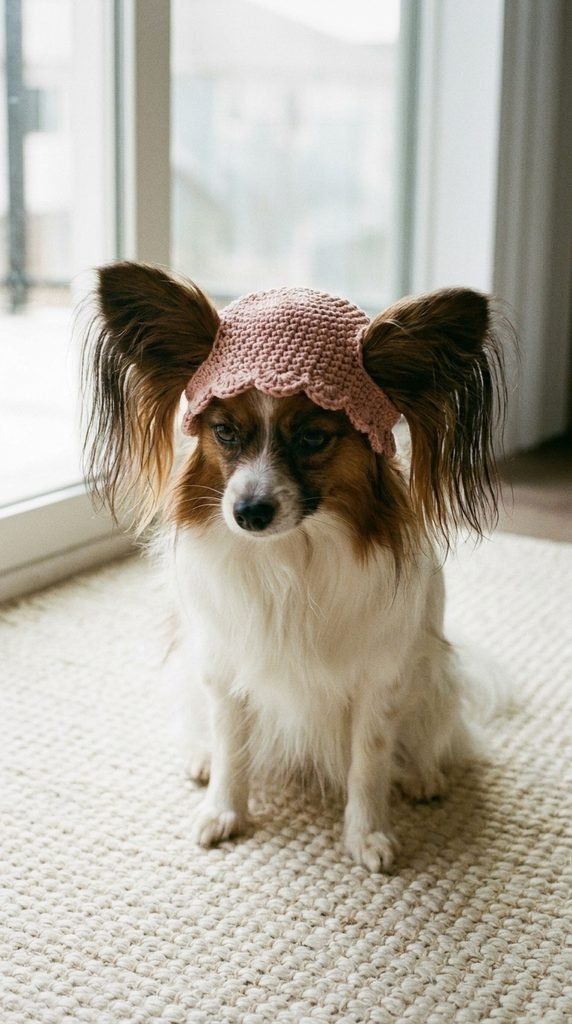
The blush Papillon hat is sweet because the decoration stays restrained. The scallops frame the forehead, while the large ear openings let the long feathered ears keep their natural shape.
This variation is a good lesson in adding detail without adding dangling parts. A single shallow shell row is enough to create a different look.
Pattern direction
Make a firm single-crochet cap with two measured ear openings. Add one compact shell or scallop row to the front edge only, stopping before the sides of the openings.
Fit note
Long ear hair can catch in an open edge, so keep the scallops small, closed and flat. Brush the fur away from the opening before checking the fit.
Best stitch direction: Single crochet in rounds, compact five-double-crochet shells for the edge, single crochet around openings.
6. Mustard and Cream Color-Block Pet Hat
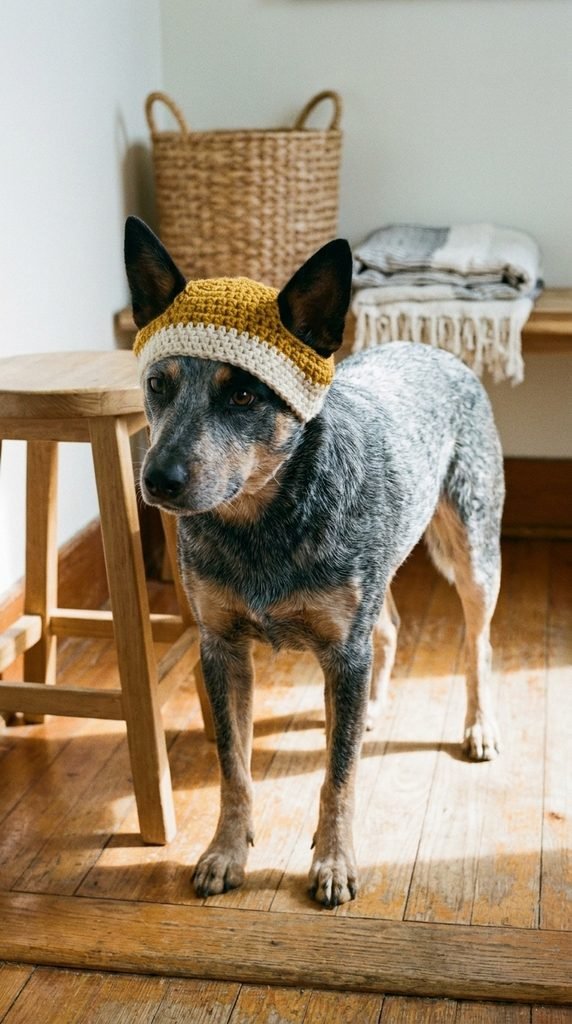
The mustard and cream hat has a little more graphic energy than the solid versions, but it still feels like something a crocheter could make on a quiet weekend.
Color blocking helps you see the hat’s structure. It also gives you a natural place to put the finished edge without adding a separate trim or a heavy embellishment.
Pattern direction
Work the crown in mustard moss stitch, change to cream for the lower band and keep the ear openings in the upper section. Finish with a compact single-crochet round.
Fit note
The Australian Cattle Dog’s upright ears create a clear opening target. Check the hat from the front and side so the cream band does not drift toward the eyes.
Best stitch direction: Moss stitch in rounds, clean color change, compact single crochet around openings and edge.
7. Muted Cranberry Striped Brim Hat
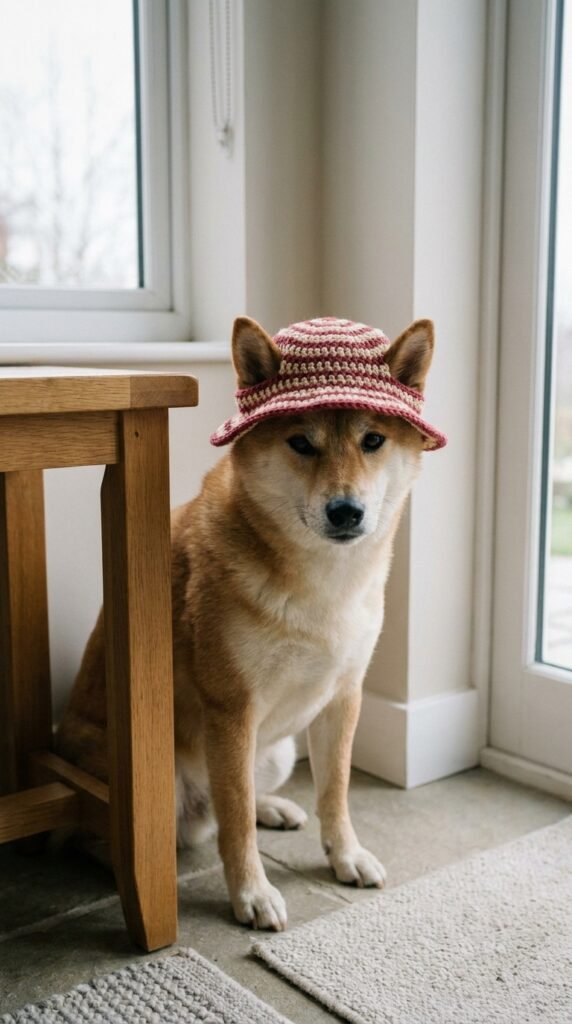
This striped version brings a little winter color to the collection. The Shiba’s upright ears make the openings obvious, while the low brim gives the hat a small vintage-hat feeling.
It is a useful seasonal variation because the color does the decorating. Two-row stripes are easy to repeat, and the brim can be made short enough to preserve the dog’s view.
Pattern direction
Make a dense striped crown with two-row color changes, form the ear openings at the marked ear line and work a short flat brim from the front edge. Keep the brim shallow and firm.
Fit note
The supplied image has a broad brim. On a real sample, the brim must stay above the eye line when the pet lowers its head. Reduce the brim depth if it shades or touches the eyes.
Best stitch direction: Dense half-double crochet stripes, single crochet opening borders, short reinforced brim.
8. Dusty Blue Face-Opening Hat
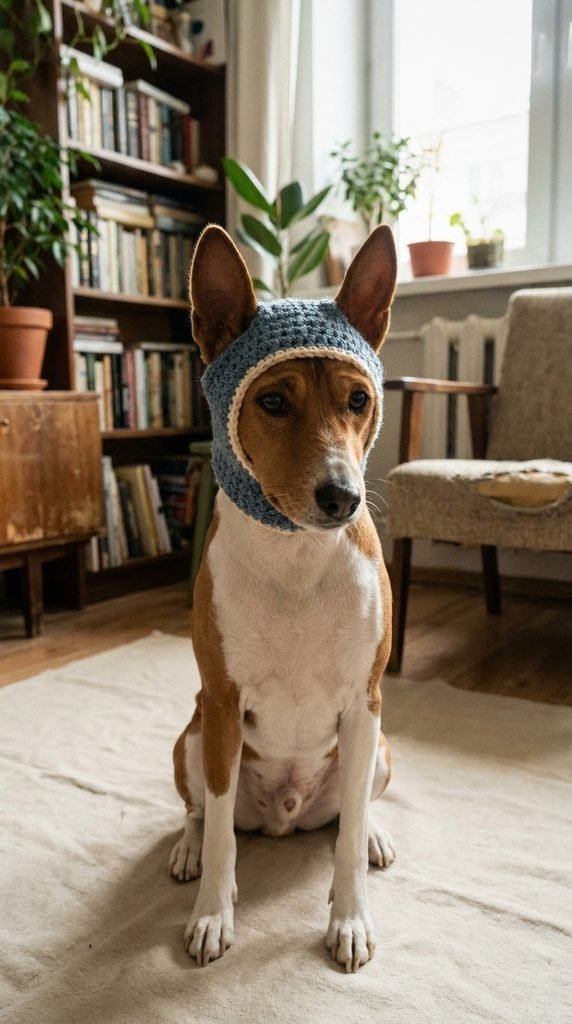
The dusty blue Basenji hat has a slightly more hooded silhouette than the beanies above. That makes it visually distinctive, but it also means the face opening deserves a stricter fit check.
The contrast edge gives the photograph a clear shape and helps a maker see where the opening ends. It should be treated as a visual finish, not as a way to hold the hat tightly against the throat.
Pattern direction
Work a dense blue crown with two ear openings, then add one cream single-crochet round around the front face edge. Keep the lower opening wide enough for the muzzle and whiskers.
Fit note
Check breathing, whiskers and jaw movement from the side. The lower edge must not sit under the throat or pull upward when the dog turns its head.
Best stitch direction: Single crochet or compact half-double crochet, contrast single-crochet face edge, reinforced opening borders.
9. Oatmeal Tweed Floppy-Ear Hood
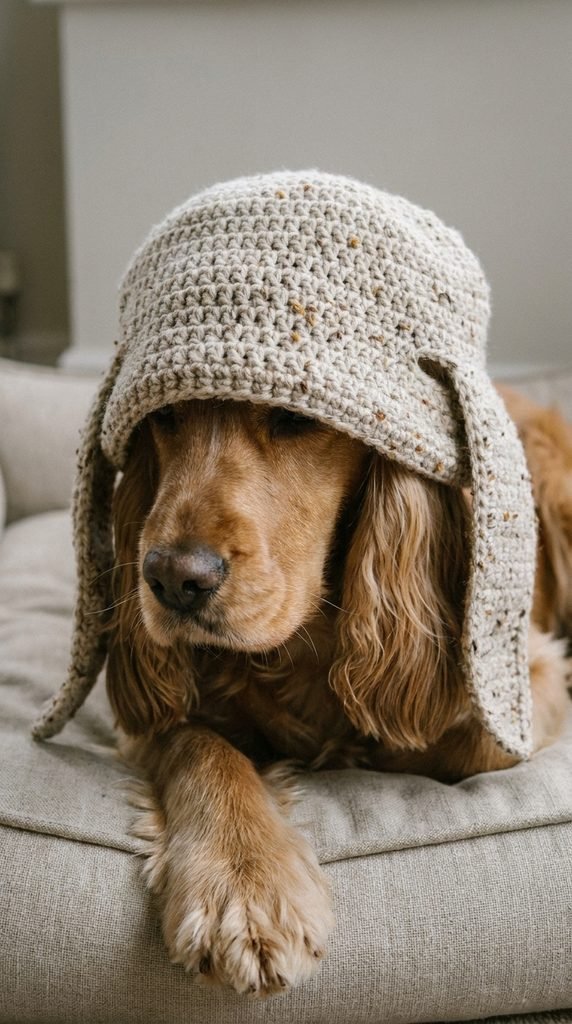
The Cocker Spaniel photograph has the softest winter mood in the set, but it is also the image that needs the most editorial honesty. The front edge sits low and the side panels drape heavily, so it should not be copied as-is.
The idea is still worth keeping because floppy ears need a different opening strategy from upright ears. The safer version uses shorter side channels, a clear face opening and a lighter fabric.
Pattern direction
Make a shallow hood in dense half-double crochet, then create two elongated side openings that let the ears fall naturally. Shorten the front edge so both eyes remain fully visible and finish the side panels above the throat.
Fit note
The finished sample must allow the ears to fall without pulling, keep the eyes and whiskers clear and leave the throat completely open. The supplied image is inspiration only until those corrections are made.
Best stitch direction: Half-double crochet rows, elongated side opening chains, compact single-crochet face edge.
Reference correction: The supplied Cocker Spaniel photograph is a mood reference, not a final safe-fit reference. The front edge must be raised and the side panels shortened before publishing the corrected sample.
10. Charcoal and Sage Cat Hat
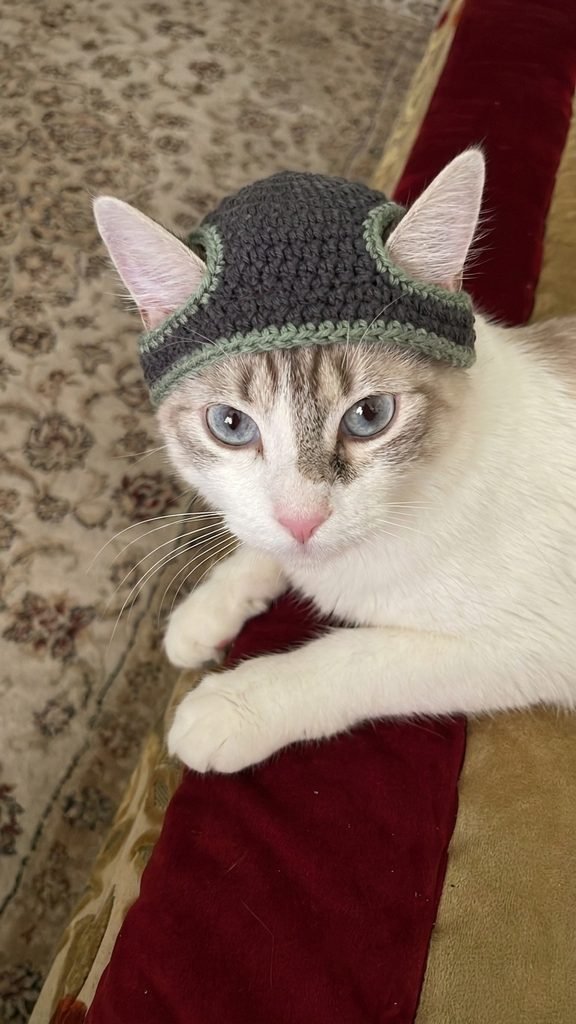
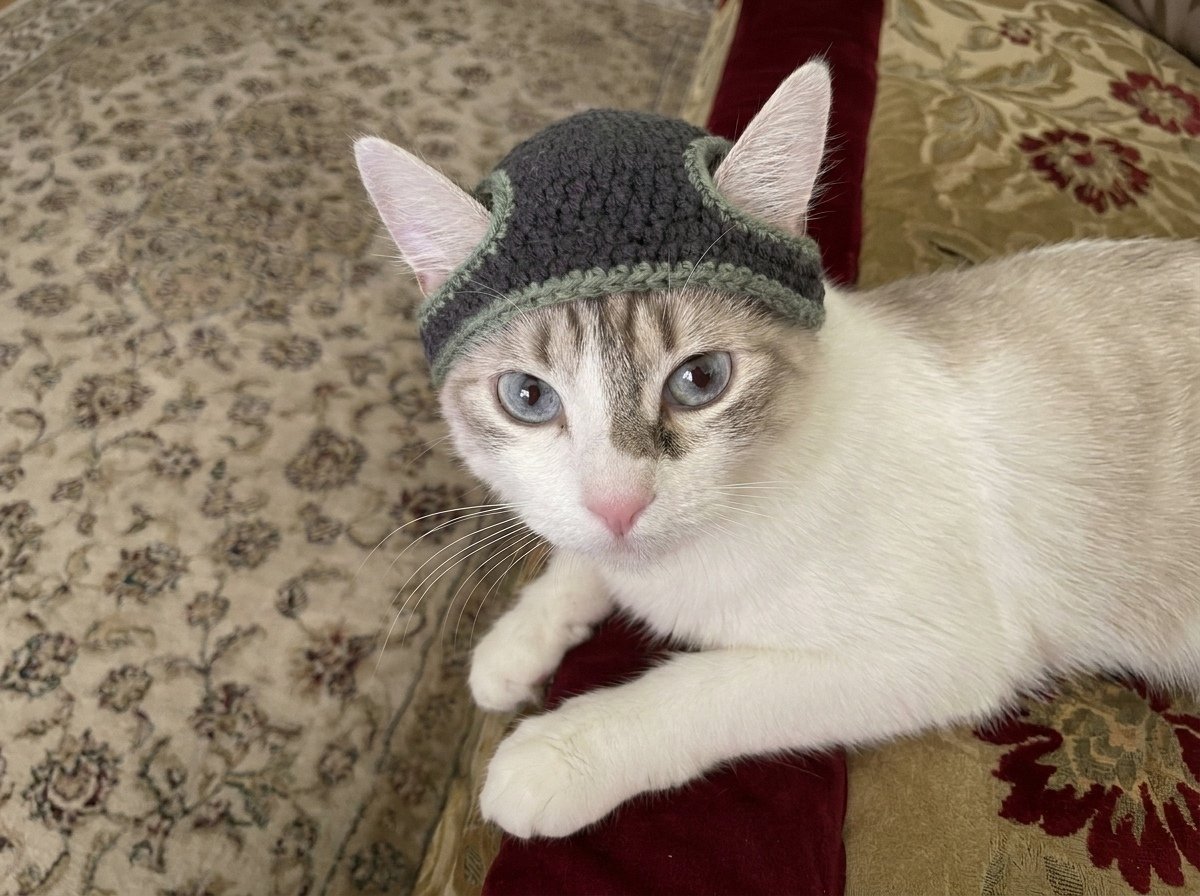
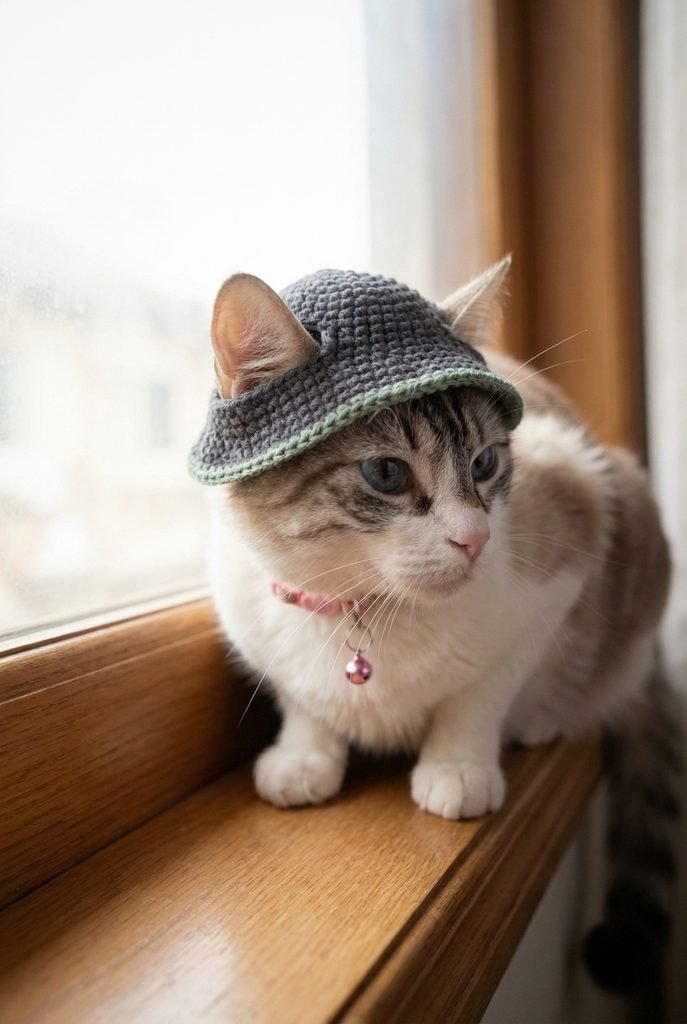
A cat hat can be cute in a single calm photograph, but cats have a very clear vote on whether an accessory stays on. This charcoal and sage version is therefore a brief, supervised portrait prop rather than an everyday item.
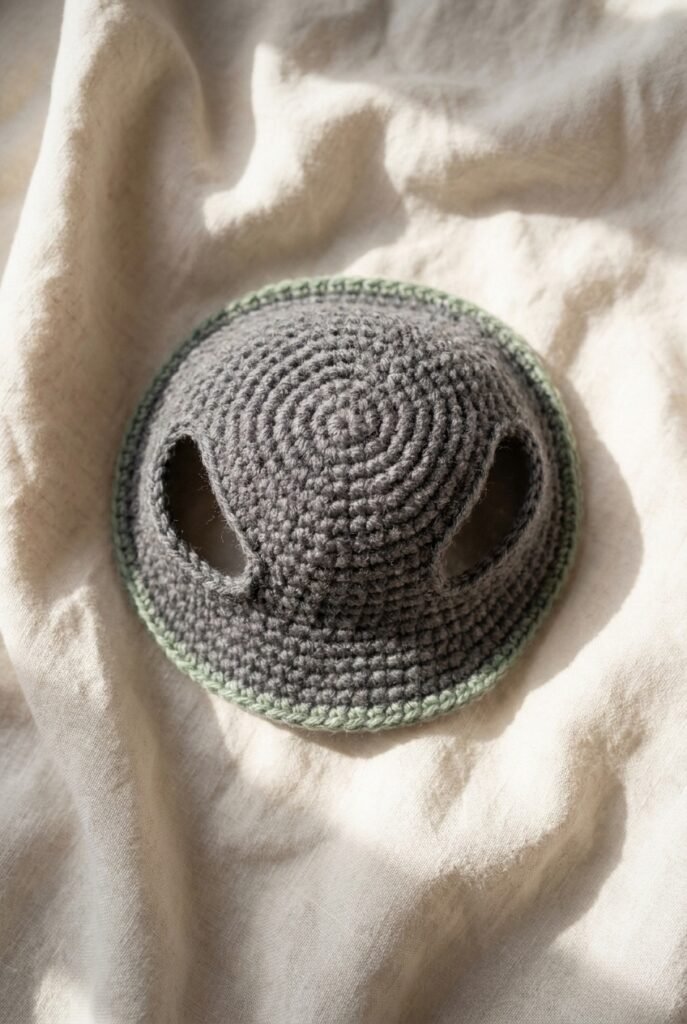
The smooth charcoal crown and sage edge are visually clean, and the two ear openings make the construction easy to understand. The flat-lay reference also shows the holes and finished edge more clearly than a front portrait alone.
Pattern direction
Work a small dense single-crochet crown, form two measured ear openings and finish the forehead edge and openings with one sage round. Do not attach bells, ties, elastic or dangling decorations to the hat.
Fit note
Leave the cat’s eyes, whiskers, nose and mouth completely clear. Keep the openings generous enough for the ears to move naturally and remove the hat if the cat freezes, paws, hides or tries to escape.
Best stitch direction: Single crochet in rounds, chain-space ear openings, contrast single-crochet edging.
Cat note: Use the cat version only for a short supervised portrait. The crochet hat must never replace a breakaway collar, and no bell belongs on the crochet item.
How to Check the Ear Openings Before a Photograph
Place the hat on the pet for only a few seconds at first. Check the front, both sides and the top. The ears should move naturally through the openings without being folded, pulled forward or pressed against the edge. The hat should stay above the eyes and leave the nose, mouth, whiskers and throat completely clear.
Take the hat off, inspect the fur and repeat the check after a short break. A pet that looks still is not necessarily comfortable, so watch for subtle stress cues. If the hat needs a cord or tight elastic to stay on, change the construction instead.
Crochet Pet Hat Safety Notes
- Use the hat only for brief, supervised indoor photographs.
- Keep eyes, ears, whiskers, mouth, breathing and natural movement unobstructed.
- Remove it before sleep, crating, walks, rough play, chewing or unsupervised time.
- Do not add wire, beads, bells, pom-poms, long ties, elastic or loose fringe.
- Wash and dry the sample, then inspect the seams and openings before reuse.
Crochet Pet Hat FAQs
Can a dog wear a crochet hat all day?
No. These designs are brief, supervised photo accessories. They are not intended for all-day wear, sleep, outdoor activity or situations where the pet cannot remove the item.
How large should the ear openings be?
Measure the widest part of each ear and add only the clearance needed for free movement. The correct opening depends on the pet’s ear shape, fur and head position, so a generic breed size is not reliable.
What yarn is best for a crochet pet hat?
Choose smooth, washable cotton or a soft stable blend. Avoid fuzzy yarn, loose novelty fibers and open loops that can catch on fur, claws or teeth.
Can I make a crochet hat for a cat?
Only as a very brief supervised photo prop if the cat remains calm. Leave the face and ears clear, never add a bell or tie to the hat and stop at the first stress cue.
Are these patterns tested?
The supplied photographs are visual references. The individual guides are adjustable, photo-matched prototype drafts until each sample is physically crocheted, washed and fit-tested on the intended pet.