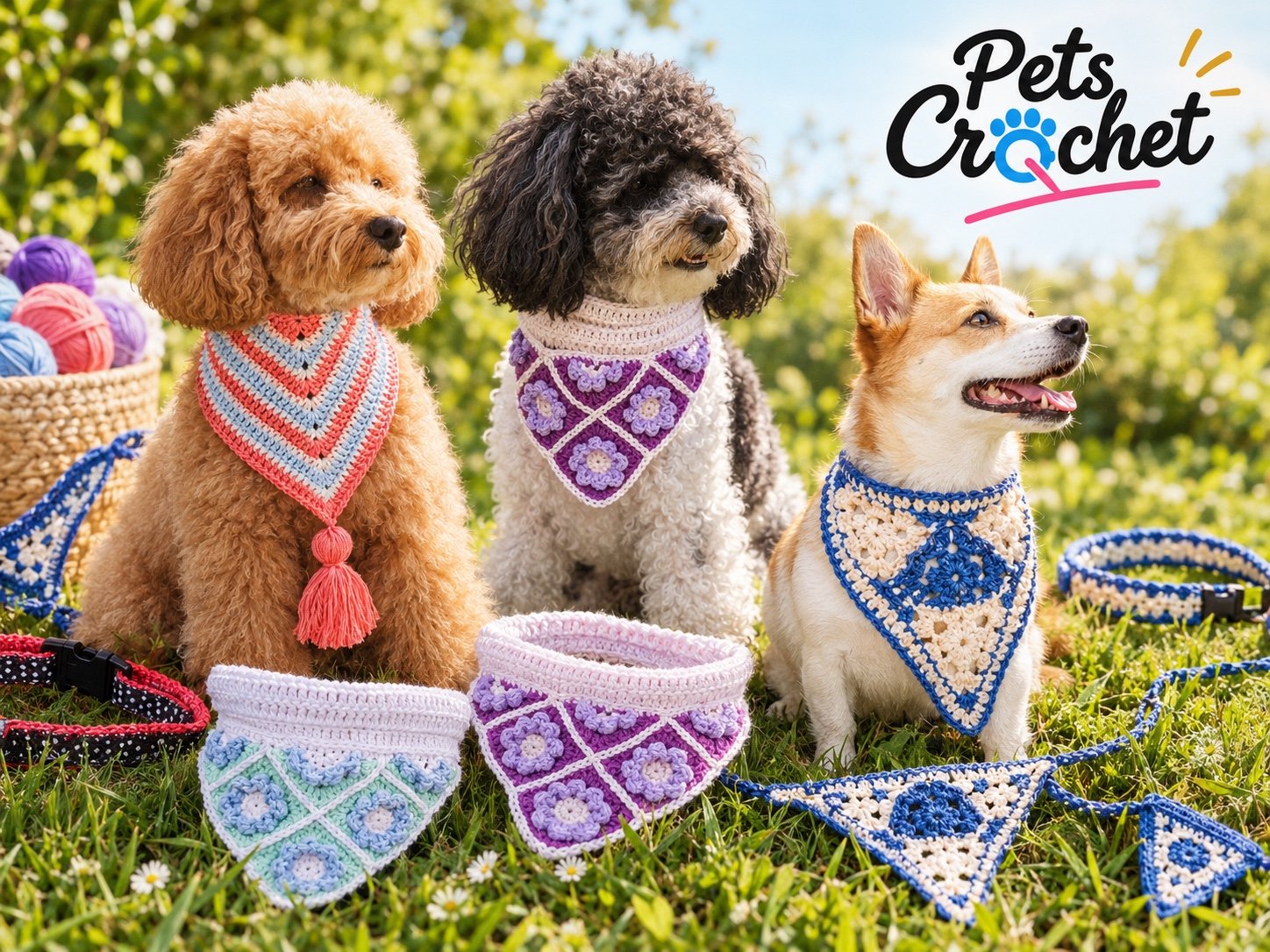
A crochet dog bandana can be a small triangle of stripes, a patchwork of open motifs or a row of flowers tucked onto a collar. These three patterns take different routes to that familiar pointed shape, so there is more to choose from than colour alone.
Gina has bold cream-and-blue openwork. Lolo builds its stripes a row at a time. Millie joins floral squares and half triangles, then adds a sleeve for an existing collar. Each style has its own free PDF guide with materials, the making route and reference photos.
Choose your bandana style
| Pattern | How it is made | Attachment |
|---|---|---|
| Gina | Four small triangles joined into one larger triangle, with a three-round border. | Two crocheted ties. |
| Lolo | Alternating single and double crochet rows in three colours. | A continuous top strip with ties. |
| Millie | Three floral squares and three half triangles with visible joins. | A folded sleeve over an existing collar. |
Start with the attachment you want to make, then look at the fabric. A collar sleeve needs room for the actual collar and its fittings. A tied style needs a separate check of the triangle, the ties and the finished knot.
1. Gina: Cream-and-Blue Motif Bandana
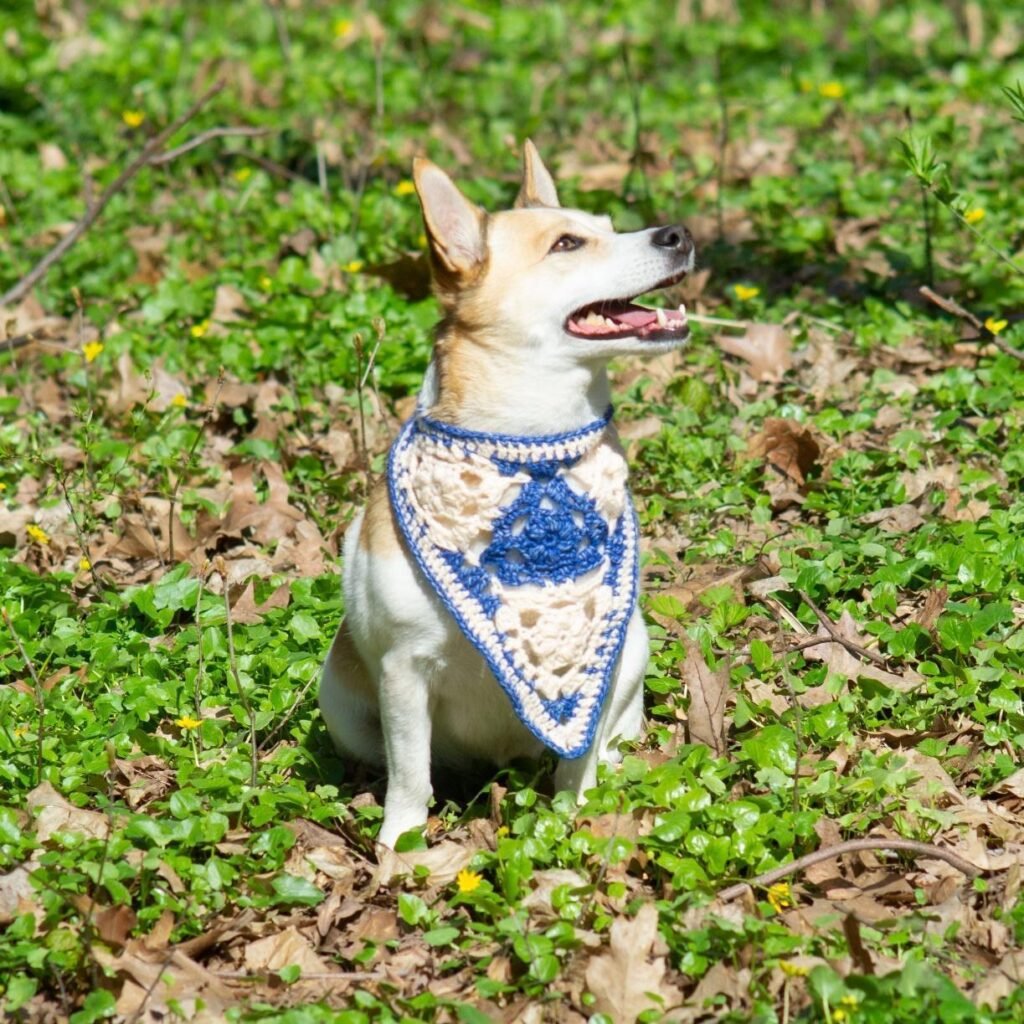
The cream centre gives the blue motifs room to stand out. Puff stitches add small raised details, while the chain spaces keep the triangle open. A cream border brings the four pieces together and softens the strong colour contrast.
This is a good choice if you enjoy making motifs and watching them connect. You finish the cream triangle first, then join the three blue triangles during their last round. The ties grow from the border, so there is no separate strap to sew across the top.
Notice the shared corners
Each corner of the centre motif meets two outer motifs. It helps to lay the pieces flat before making the last join; that makes it easier to spot a triangle turned the wrong way.
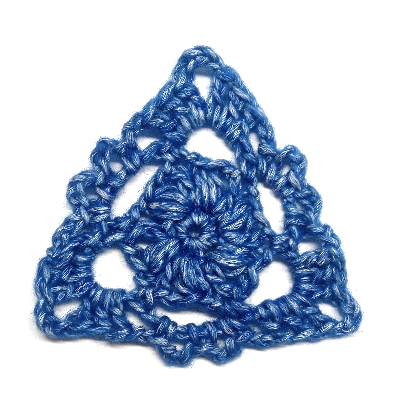
The reference uses a 5.5 mm hook and Portobello cotton-blend yarn. Its triangle side is about 36 cm, with 18 cm ties. Those figures describe the crochet pieces, so check them against an actual template for your dog before choosing this size. The guide explains the joins and tie-length trial.
2. Lolo: Soft Stripes with a Simple Triangle
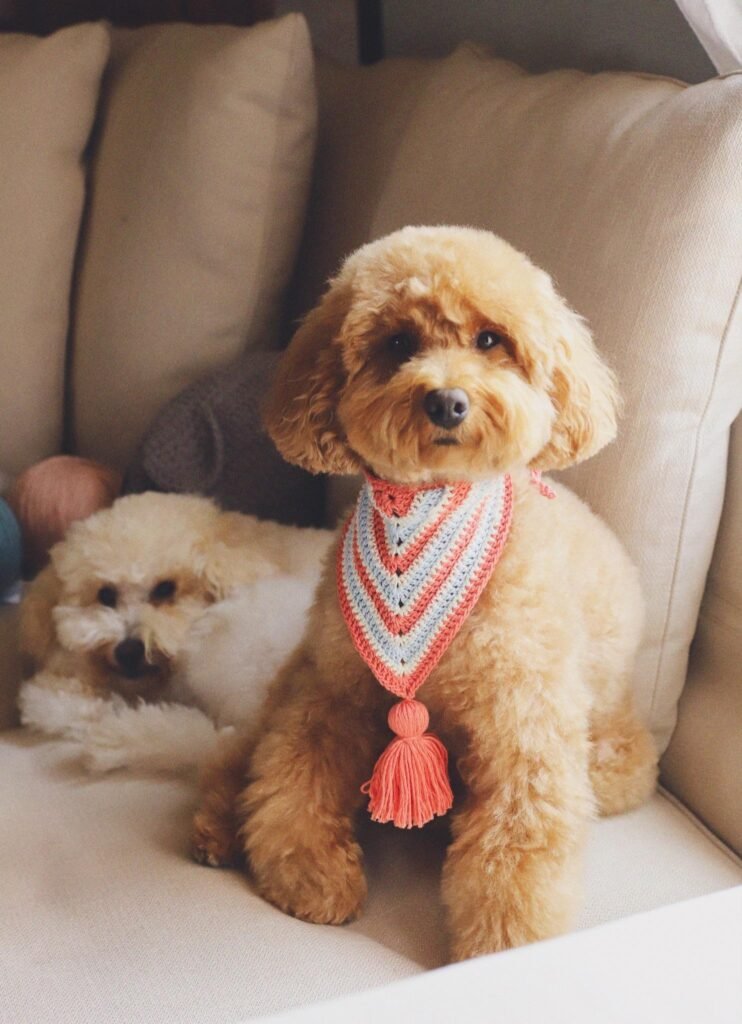
Salmon stripes give this bandana warmth, with ecru between the coloured rows and sky blue breaking up the pattern. The V shape comes from increases at both outer edges and on either side of the centre space.
Of the three, Lolo has the most familiar row-by-row structure. You alternate single crochet and double crochet, changing colour as you go. If you already know those stitches and can count your turning chains, the repeats are straightforward to follow. Keep an eye on the two sides of the centre: they should have the same number of stitches.
Measure the top and the ties separately
The reference drawing shows a 23 cm top edge on the triangle and a 72 cm strap from tip to tip. The sloping side is about 19 cm. The full strap measurement includes both ties; it is not a neck-size label.
The guide uses a 3 mm hook as a starting point with Cotton M cotton. The photographed tassel is a decorative detail. For a dog-use version, leave it off and secure the yarn ends at the point. That finishing change needs checking on your own sample.
3. Millie: Floral Bandana That Slides Over a Collar
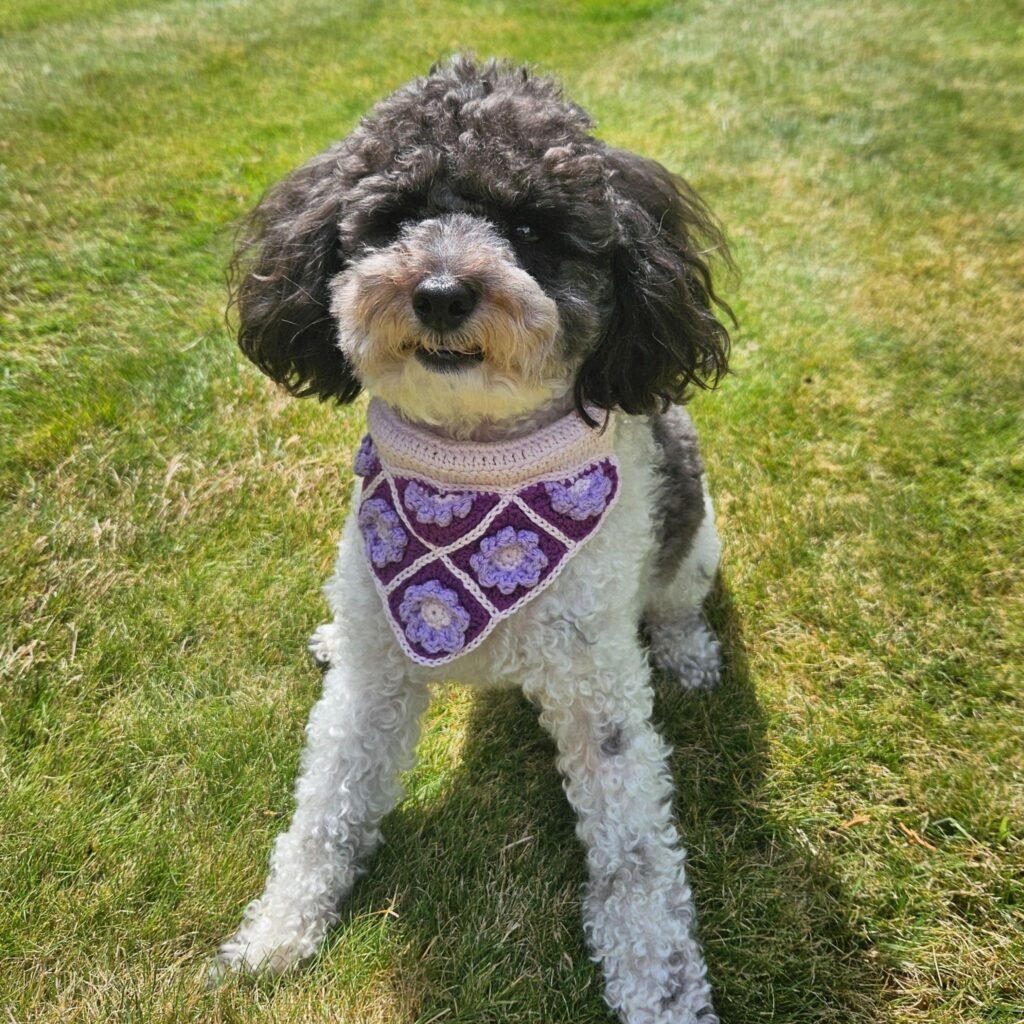
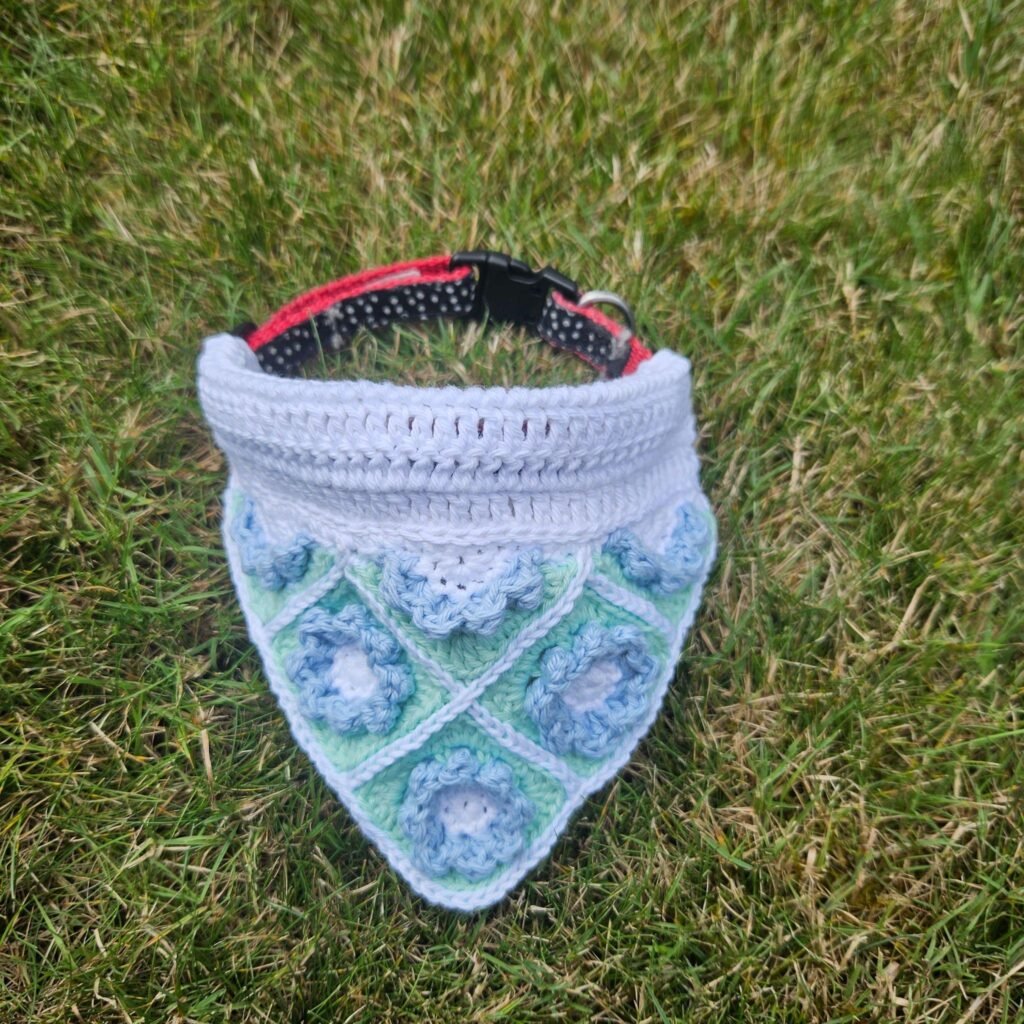
Small flower centres, raised petals and contrasting joins give Millie a patchwork look. The full squares turn into diamonds in the finished triangle, with half motifs making a straight top edge. Purple and blue-green examples show two colour choices for this same pattern.
Millie is the one to choose if you want to work with an existing collar. Instead of making ties, you crochet a strip along the top and fold it to the back. Closing that long edge creates a tube for the collar to slide through.
Check the sleeve before closing it
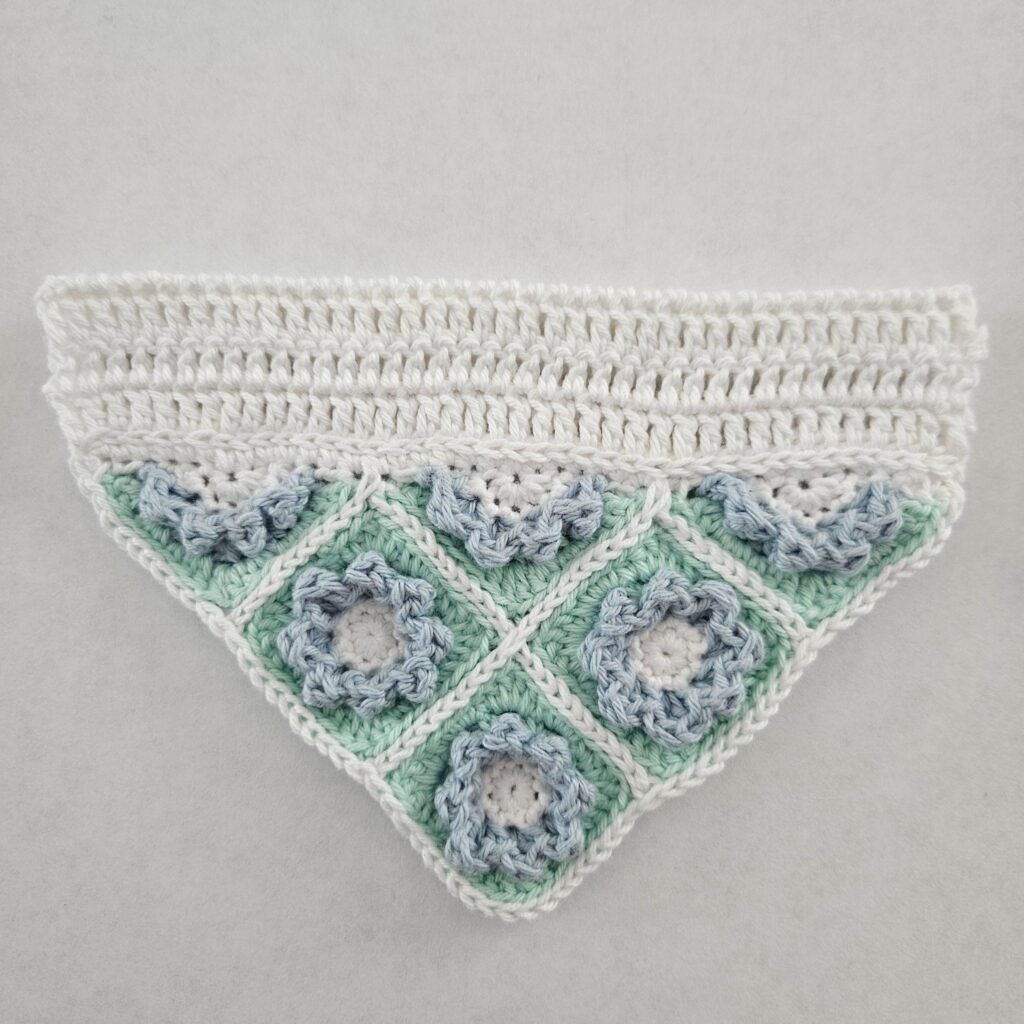
The sleeve needs to fit the collar strap and anything that must pass through it. Check this off the dog while the final seam is still open. Keep the collar buckle, tags, lead ring and fastening clear.
The reference bandana is about 23 cm wide and uses Friends Cotton 8/4 with a 3.5 mm hook. The square gauge is 7.5 cm from corner to opposite corner, measured diagonally. Measuring a side instead would make a much larger motif.
What to gather before you start
Choose the yarn and hook for the individual pattern, rather than using one hook for all three. Gina’s larger-hook cotton blend gives a different fabric from the finer cotton in Lolo and Millie.
Keep a tape measure, blunt yarn needle, scissors and removable stitch markers nearby. Marking the central space and edge stitches helps on Lolo. For Millie, markers in the corner chains make the joining stage easier to follow. A flat surface is useful for checking both motif layouts.
Make and finish a swatch before committing to the full bandana. Check the fabric after it has dried, then record the gauge and dimensions. The ball and cone sizes in the guides are material references, not a promise that every yarn substitution or larger size will use the same amount.
Fit comes before the finishing touches
Measure your dog where the accessory would sit, then compare a paper template with the planned triangle. Check its drop as well as its width. Keep the point, ties and any loose yarn away from the mouth, and make sure the dog can move, breathe and swallow normally.
Use a bandana only if your dog is comfortable with it. Remove it if they paw at it, freeze, try to chew it or show discomfort. Supervise use and take it off for sleep, rough play, crating or time alone.
These are decorative crochet accessories. Attach a lead only to suitable walking equipment, and keep the collar’s fittings and identification unobstructed. A crocheted sleeve does not replace the collar beneath it.
Care after the first fitting
Follow the actual yarn label and try the intended cleaning method on your swatch. Gina’s reference finish calls for cold water, no spin and flat drying. A substitute yarn may need different care.
For Millie, remove the crochet from the collar before cleaning it. After drying, check for stretched ties, loose ends, distorted joins or a sleeve that has changed size. Recheck the fit before using the accessory again.
Questions before choosing a pattern
Which crochet dog bandana pattern is the simplest?
Lolo has the simplest construction to follow if you know single crochet, double crochet and turning chains. Gina adds puff stitches and joining as you go; Millie adds front-post stitches, half motifs and a folded sleeve. None is a substitute for checking your own tension and fit.
Are these three different patterns?
Yes. Gina, Lolo and Millie use different constructions. Millie’s purple and blue-green versions are colour choices for one design.
Can I make a smaller or larger bandana?
Lolo lets you stop at an earlier odd row or continue the repeats. Gina and Millie need a motif-size trial if you want to change the triangle itself. Tie length and collar-sleeve depth are separate adjustments. The guides explain the sampling steps; added size and finishing changes have not been physically tested.
Does every style tie around the neck?
No. Gina and Lolo have ties. Millie slides onto an existing collar through its top sleeve.
What is included in the free PDFs?
Each individual guide includes materials, reference measurements, the full making route, assembly notes and the supplied photo pages. Choose the download under the bandana you want to make.