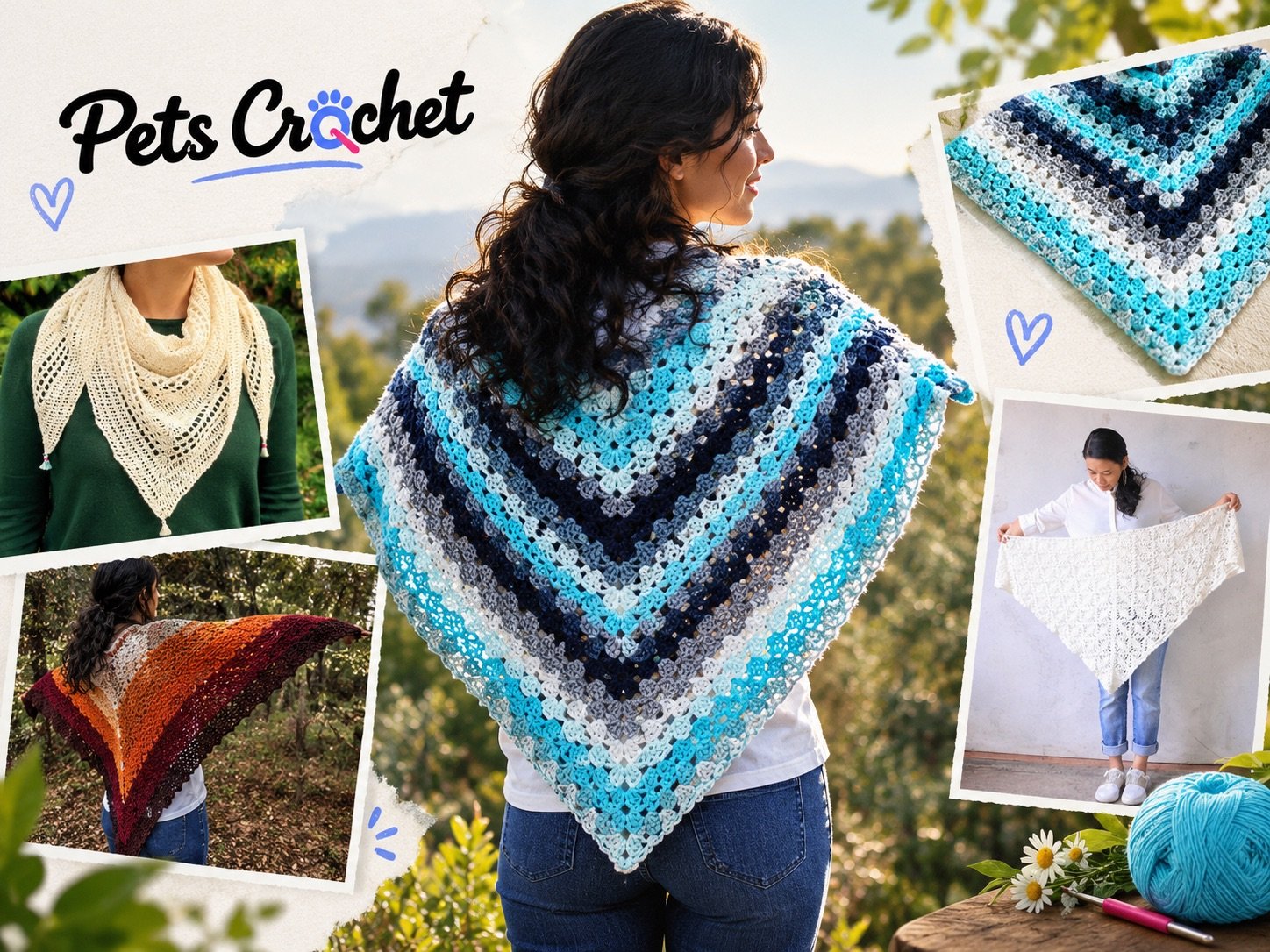
A crochet shawl can be a bright triangle scarf, a generous textured wrap or an airy layer with lace you can see right through. These five patterns give you a choice of all three, with a free PDF download under each design.
Start with the look you would actually wear, then check the stitches and yarn. Aquamarine Joy offers a simple cluster repeat, Genara adds herringbone texture, Blooms and Dunes brings puff stitches, Tarumi focuses on charted lace, and Crofton uses linked double crochet. There is no need to choose a complicated pattern just because you like the finished photo.
Compare the five shawls
| Pattern | Choose it for | Yarn | Hook |
|---|---|---|---|
| Aquamarine Joy | A first triangle shawl | Lightweight #3 yarn; one 795-yard / 727-metre cake | 4 mm |
| Genara | Gradient yarn and subtle texture | Fingering-weight cotton; approximately 1,000 metres | 3.5 mm |
| Blooms and Dunes | Raised texture and a generous wrap | DK/light worsted acrylic; six listed 100 g skeins across four colours | 5 mm |
| Tarumi | Reading a crochet shawl diagram | Your chosen yarn; no fixed quantity specified | Match the yarn and desired fabric |
| Crofton | Linked stitches and understated eyelets | Fingering weight; approximately 650 yards | 3.5 mm |
1. Aquamarine Joy: An Easy Crochet Triangle Shawl
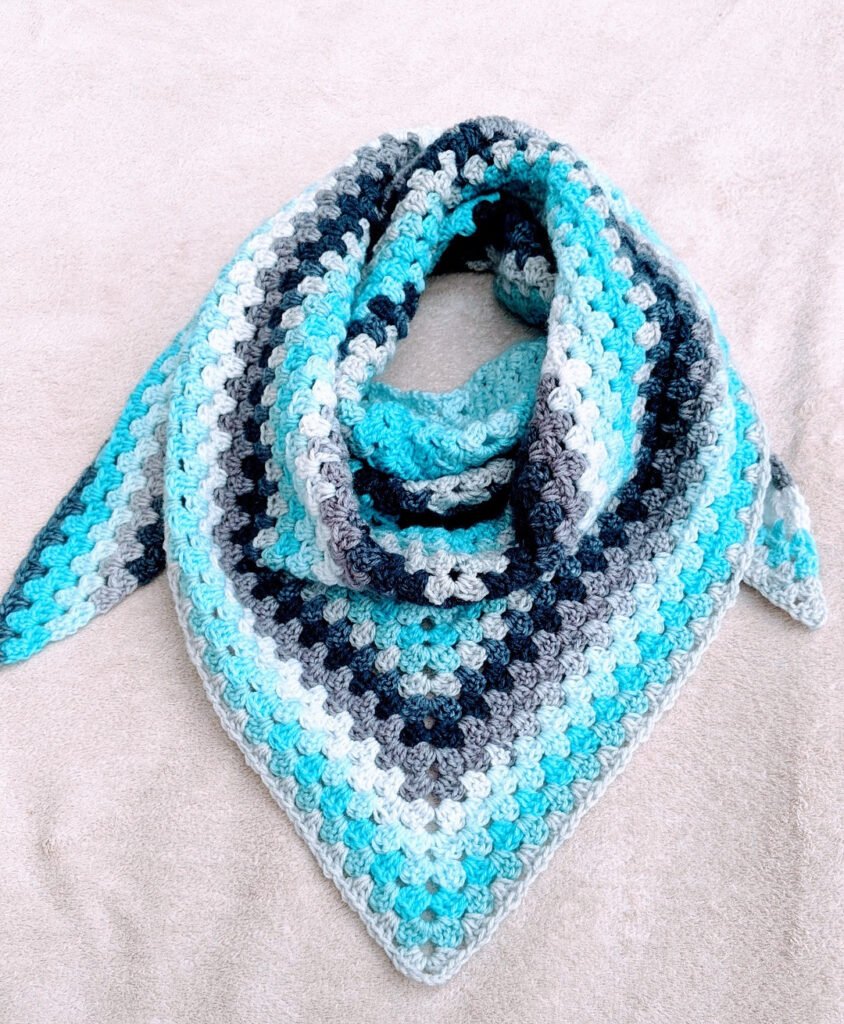
Bright turquoise stripes make Aquamarine Joy stand out, while grey, white and dark blue give the colours some contrast. The granny-style clusters leave small spaces between the stitches, and the triangle folds neatly into a pointed scarf.
Of these five free crochet shawl patterns, this is the clearest starting point for a newer crocheter. It uses chains, slip stitches and groups of double crochet, with photos showing the early rows. Once you understand the increases at the edges and centre, the same structure carries you through the shawl.
It is also a one-skein shawl, with a specific yarn requirement: the sample uses one large Caron Skinny Cakes ball containing 795 yards. A smaller ball will not necessarily make the same size. The pattern has 48 rows, but you can work fewer or more to adjust the triangle, allowing extra yarn for a larger shawl.
- Yarn: Lightweight #3 yarn; one 795-yard / 727-metre cake
- Hook: 4 mm
- Finished size: 55 × 27 in / 140 × 69 cm
Why choose it: Try it if you want a repeat you can settle into and a yarn cake that handles the colour changes.
2. Genara: A Gradient Crochet Shawl with Herringbone Texture
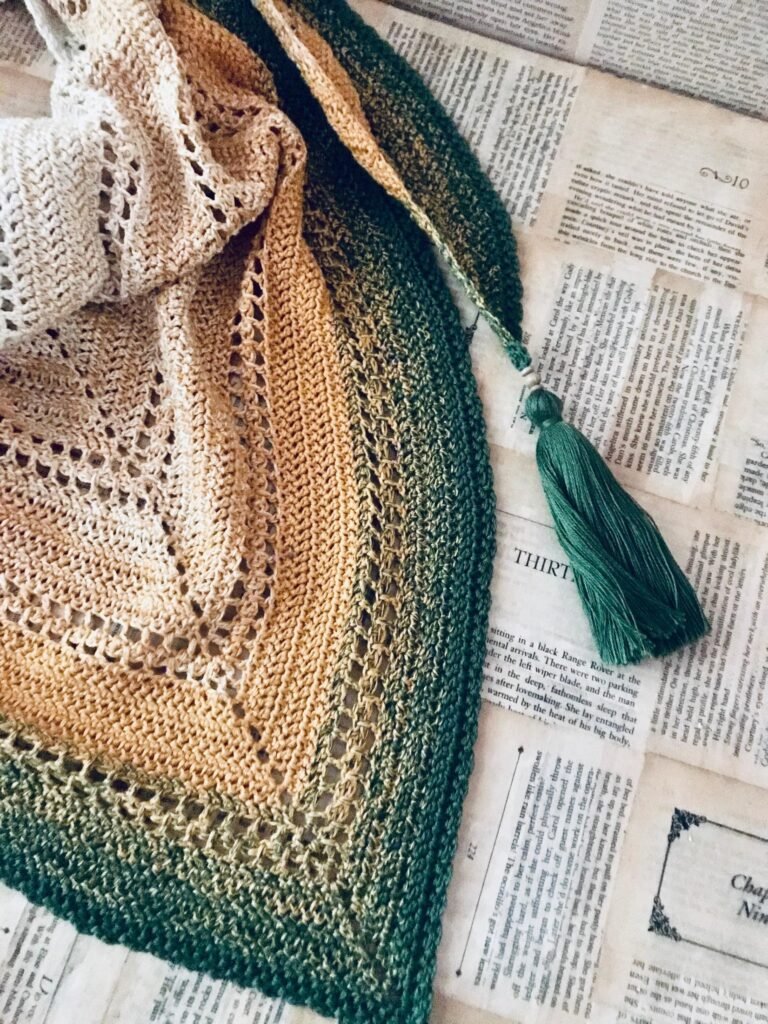
Genara moves from pale cream through warm golden tones to a deep green edge. Narrow openwork bands separate the more solid sections, so the colour changes have a little space around them. A corner tassel finishes the photographed shawl.
Herringbone double crochet gives the main fabric its texture. Between those sections, double-crochet posts and chain spaces form the dividers. The PDF includes photos, a diagram and a stitch-count summary, which are useful when you move from a solid section into the more detailed rows.
This top-down triangle is a good choice when you want something more involved than a basic granny shawl without making every row a new stitch combination. The sample uses a four-ply cotton gradient yarn; the pattern also suggests fingering-weight cotton or acrylic. Swatch your substitute to check the fabric before committing to the whole shawl.
- Yarn: Fingering-weight cotton; approximately 1,000 metres
- Hook: 3.5 mm
- Finished size: Approximately 28 in at the centre spine after blocking
Why choose it: Choose a slow colour gradient to let the herringbone sections and openwork bands remain visible.
3. Blooms and Dunes: A Textured Crochet Shawl with Puff Stitches
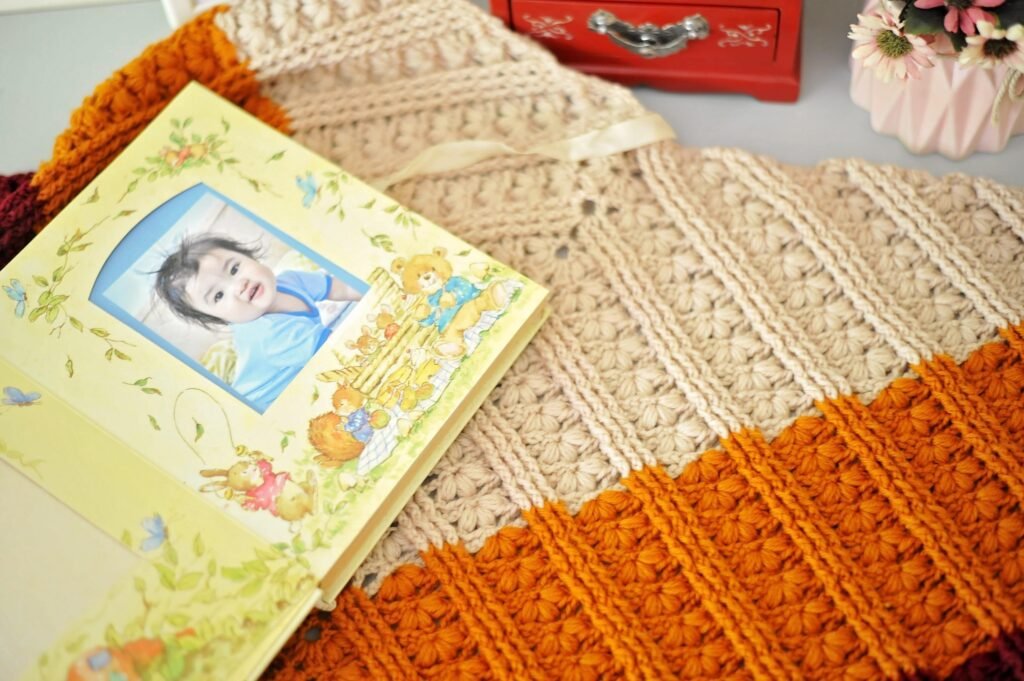
Blooms and Dunes puts texture first. Raised lines and puff-stitch details run through the fabric, and the cream and warm orange tones in the photograph make those details easy to see. It is the option to look at when you want more surface interest than a plain stitch can give.
The triangle grows from the top down using front-post double crochet, back-post double crochet and puff stitches. Those are the techniques to practise before starting if they are new to you. The PDF includes close-up photos to help you follow how the stitch groups sit together.
At a listed 66-inch wingspan, this is a generous shawl for wrapping around the shoulders. The materials list calls for beige, clay, maroon and brown yarn, with six skeins in total. Treat that as the shopping list for the sample rather than a promise that every substitute will use exactly the same amount.
The pattern repeats a four-row section to build the fabric. Keep track of the row you finish on, because the right and wrong sides use different stitch arrangements.
- Yarn: DK/light worsted acrylic; six listed 100 g skeins across four colours
- Hook: 5 mm
- Finished size: 66 in wingspan × 35 in centre spine after blocking
Why choose it: Pick this one for puff stitches, visible ridges and broad colour sections. A plain top underneath will let the texture show.
4. Tarumi: A Crochet Lace Shawl for Chart Lovers
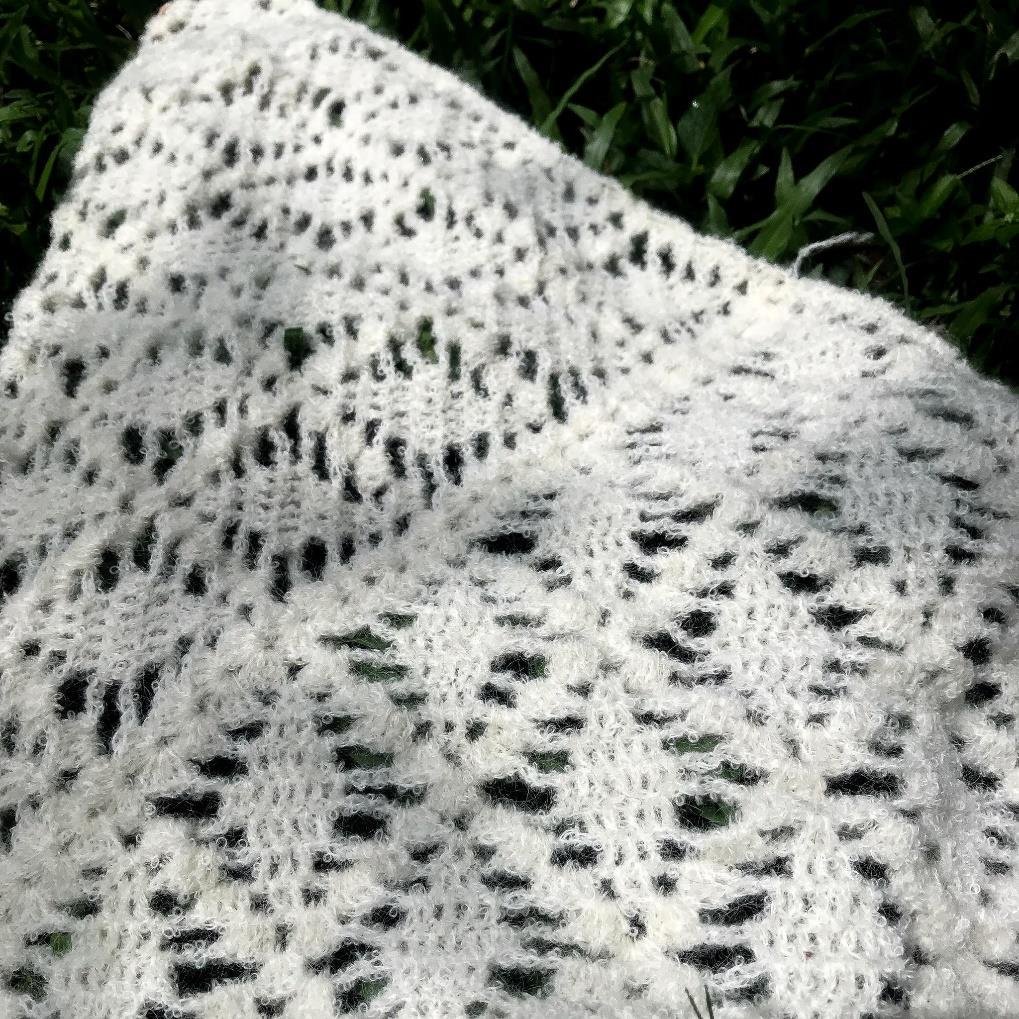
Tarumi has the most open, lacy appearance in this collection. In the white sample, repeating spaces and fan-shaped groups create a delicate pattern across the fabric. A simple colour makes it easier to follow the lace with your eye.
If you like working from a crochet shawl diagram, this is the one to open first. The PDF is chart-led, with a stitch-symbol key, the main shawl chart and a separate edging chart. It tells you to repeat rows 7–11 to reach your preferred length, then finish on row 11 before beginning the border.
The materials are deliberately flexible: choose your yarn, then a hook that gives you the fabric you want. There is no fixed yardage or finished size to rely on. Make a swatch and plan extra yarn for the edging, rather than buying the same quantity listed for a different shawl.
Tarumi is better suited to someone comfortable following symbols than someone looking for every row written out in sentences. Print or enlarge the chart so you can mark your place as you work.
- Yarn: Your chosen yarn; no fixed quantity specified
- Hook: Match the yarn and desired fabric
- Finished size: Adjustable; no fixed finished dimensions listed
Why choose it: Choose it for an airy crochet lace shawl and a chart-based project, especially if you enjoy seeing a motif emerge over several rows.
5. Crofton: A Solid-Colour Shawl with Linked Double Crochet
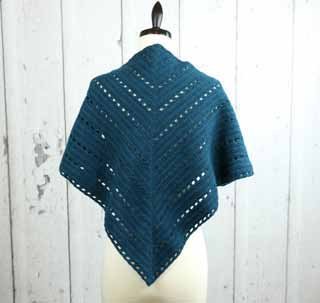
Crofton keeps the colour simple and lets the stitch pattern carry the design. The deep teal sample has solid sections broken by narrow rows of eyelets, all following the triangle down toward its point. It would pair easily with a plain shirt or a simple dress.
Linked double crochet is the main technique. Each stitch connects to the previous one through its horizontal bar, giving you a different construction to explore from ordinary double crochet. The pattern is marked intermediate and includes written instructions, a chart and an explanation of the linked stitch.
The listed size is 42 inches wide by 24 inches high, smaller than the finished measurements given for Aquamarine Joy and Blooms and Dunes. That makes it worth considering if you prefer a more compact shoulder layer.
Use the written instructions alongside the chart. The PDF notes that part of the chart is shortened to fit the page, so it should not be treated as a complete stitch-count guide for every later row.
- Yarn: Fingering weight; approximately 650 yards
- Hook: 3.5 mm
- Finished size: 42 in wide × 24 in high
Why choose it: Choose a solid or gently tonal fingering-weight yarn so the eyelet bands and linked stitches stay easy to see.
Before You Start Your Crochet Shawl
Check the yarn quantity, not just the ball count
One ball can mean very different lengths. Aquamarine Joy uses a large 795-yard cake, while Crofton lists 650 yards of fingering-weight yarn. Compare yarn weight and metres or yards when substituting. Keep some yarn aside for any edging or tassels.
Measure both the width and the centre depth
A triangle’s longest edge and its centre spine tell you different things about how it will fit. Measure a shawl you already enjoy wearing, or lay out a scarf at a similar size. For the patterns with adjustable repeats, follow their stopping instructions so the border begins on the right row.
Let the stitches help you choose a colour
Granny clusters work well with stripes, while gradient yarn highlights Genara’s widening sections. A solid shade makes it easier to see Tarumi’s lace or Crofton’s eyelet rows. For Blooms and Dunes, think about how each colour will separate the textured bands.
Finish according to your yarn
Weave in the ends and follow the yarn label when washing or blocking. Use the listed measurements as a guide where provided, and shape the triangle evenly without forcing it. Yarn choice and tension affect the finished size and drape.
Crochet Shawl FAQs
Which crochet shawl is best for beginners?
Aquamarine Joy is the most approachable choice here. It is labelled easy/beginner and uses a repeating arrangement of double-crochet clusters, with photos of the starting rows. Genara, Blooms and Dunes and Crofton introduce extra stitch techniques; Tarumi relies on reading charts.
Can I crochet a shawl with one skein?
Yes, if the skein has enough yarn for the pattern. Aquamarine Joy uses one 795-yard / 727-metre cake. Check the length on your label before treating a different ball as an equivalent.
Which free PDF includes a crochet shawl diagram?
Genara, Tarumi and Crofton include diagrams or charts. Tarumi is the most chart-focused of the three. Crofton also has full written instructions and notes about the chart’s shortened section.
Can I make these shawls larger?
Several of these patterns allow you to continue the established repeats. Aquamarine Joy lets you add rows, Genara is described as adjustable, and Blooms and Dunes and Tarumi specify repeating sections. Follow each PDF’s instructions, allow more yarn and account for its edging.
Where can I get the free PDF patterns?
Use the Download free pattern PDF button beneath the shawl you want to make. Each button opens that design’s separate pattern file, so you can save it before you start.
Save the shawl you want to make, download its free PDF and check your yarn length before making your first chain.