
Bright curls, two colours held together and no stuffing: these swirly crochet cat toys start with one chain and one worked row. The colour changes come from pairing a variegated yarn with a solid shade, so even the same stitch sequence can look quite different from one sample to the next.
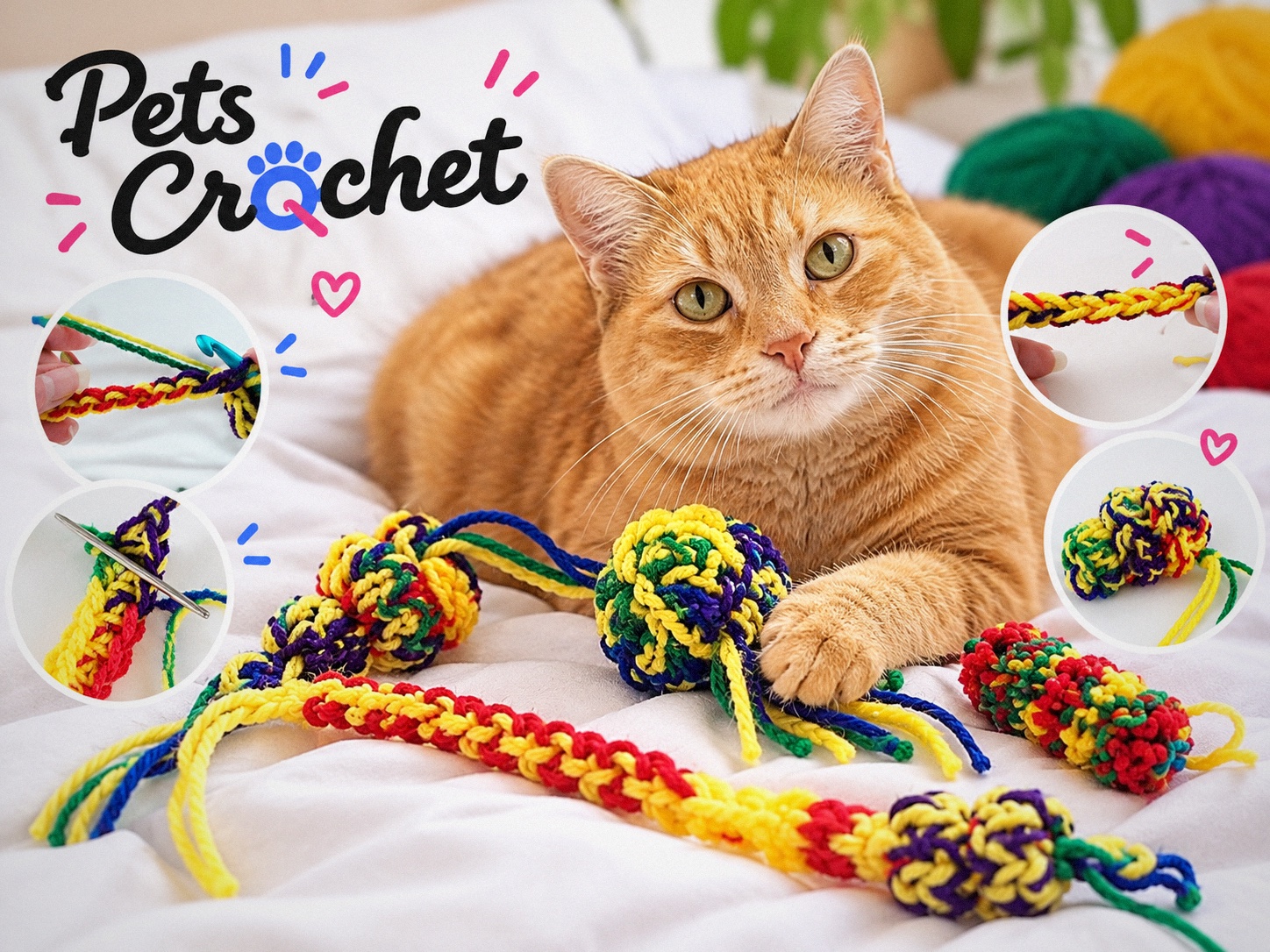
The photographs show the original version with long loose yarn ends. The free PDF keeps the unfilled crochet body and offers a proposed finish that weaves those ends into the fabric. That adaptation is unphotographed and untested. The images are construction references, not evidence of a tested pet toy.
1. An Unfilled Two-Strand Crochet Swirl

The yellow, red and blue samples share a loose corkscrew shape. You can see the solid colour running through the variegated strand, giving each curl a little contrast. The photograph groups several colour versions together, but they all use one underlying pattern.
There is no stuffed tube, separate face or sewn-on decoration in the crochet body. The curl comes from putting several taller stitches into a short run of chain anchors, then continuing with a narrower single-crochet section.
Variegated plus solid yarn gives the colour mix
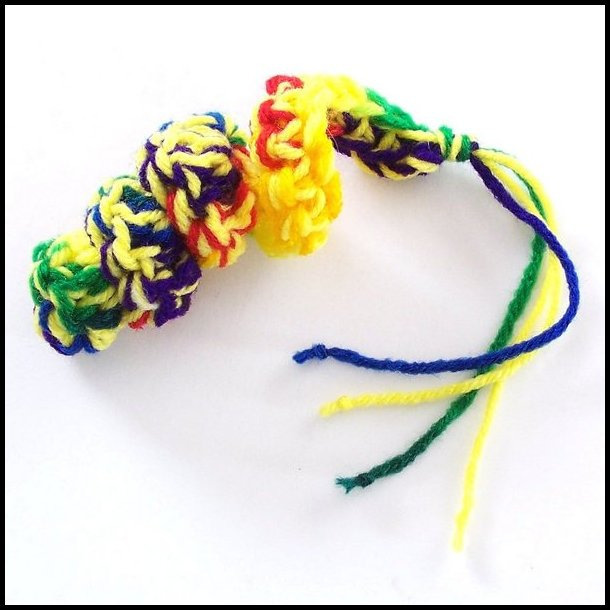
Hold both strands together from the first chain to the final stitch. The reference pairs a multicolour worsted yarn with a solid worsted yarn, using a 6.5 mm hook as the starting point. Changing the solid shade changes which colours stand out.
For a first sample, choose two yarns that travel smoothly through the hook together. Count each paired-strand loop as one chain or stitch, rather than counting the two yarns separately. Stop and correct a split strand before it gets buried under the next stitch.
The foundation has two useful sides to recognise
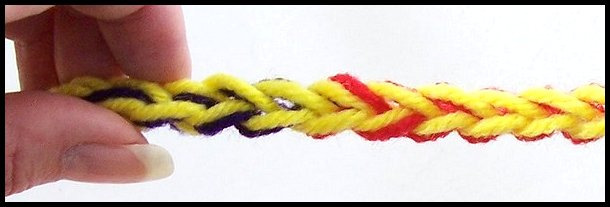
The front looks like a row of little Vs. Turn the chain over and a line of bumps appears along the back. The row is worked through those back ridges, which leaves a neat foundation edge visible alongside the new stitches.

The pattern uses a short double-crochet section followed by single crochet. Several double crochets share each of the first anchors, which encourages the strip to turn into a spiral. Let the curl form naturally and separate the coils gently after the row is complete.
A counted starting chain needs one clear convention
The guide counts the three skipped starting chains as the first double-crochet unit. With that convention, the row has 27 double-crochet units and 14 single crochets. The PDF explains the difference between worked stitches and the starting-chain unit so you can check the row without adding an extra stitch.
The finish is part of choosing a pet project
The original samples finish with a knot and four long yarn ends. The proposed guide finish weaves all four individual ends through several paths in the fabric and leaves no deliberate tassel. It does not add stuffing, catnip, bells, eyes or a hanging cord.
That is a written construction change, not a safety test. A sample needs to hold its ends without loose loops, exposed cut strands or a hard bundle in the stem. If the yarn or gauge will not do that, keep it out of pet access and choose another construction.
What the free PDF covers
The complete two-strand foundation and row, stitch-count check, back-ridge working notes, proposed woven-end finish, measurement method and all five craft photographs. A separate finish map explains the new end treatment because there is no photograph of it.
Yarn, hook and sample size
The reference uses two strands of medium-weight worsted yarn and a size K, 6.5 mm hook. Its allowance is about half an ounce of each yarn for three samples. That is a reference estimate for the original version, not a measured amount for the proposed finish or every yarn substitute.
The listed gauge is five single crochets across two inches. Gauge still matters when checking stitch openings, the curl and the ability to bury ends. A tighter or looser sample can change all three, even when the stitch count stays the same.
The original lists about 5½ inches from the swirl tip to its knot and 10½ inches including the yarn ends. Those measurements describe the fringed reference. Measure the proposed version after finishing, recording its relaxed length, curl diameter and stem separately. No finished size for the adaptation has been verified.
Before considering it for play
Stay with your cat during play, inspect the entire piece before and afterward, and put it away when the session ends. Remove it if any strand pulls out, the yarn frays, a loop opens or your cat starts chewing and swallowing the material. A woven finish and an unfilled body do not make crochet chew-proof.
Cats that chew or ingest yarn need another type of play object. The presence of a cat in a reference photograph does not establish suitability for every animal. No dog-use, wash, yarn-retention or pet-use test has been completed for this draft.
Questions before starting
Are the three colours separate patterns?
No. They are colour versions of one unfilled crochet swirl. There is one complete guide and one stitch sequence.
Is the swirl stuffed?
No. The shape comes from a worked strip curling around itself. The proposed finish also leaves it unfilled.
Does the guide reproduce the long fringe?
The photographs retain it as an original reference. The proposed written finish weaves the four ends into the fabric and does not leave a deliberate tassel.
Is it a beginner project?
The crochet row uses basic chains, single crochet and double crochet. Handling two strands, finding the back ridge and securing all four ends still need care. A simple stitch sequence does not remove the need to assess the finished object for the individual pet.
Can I wash it?
Follow the labels for both yarns and test a separate sample first. Recheck the end retention and fabric after washing. No machine-wash or drying performance has been verified.