
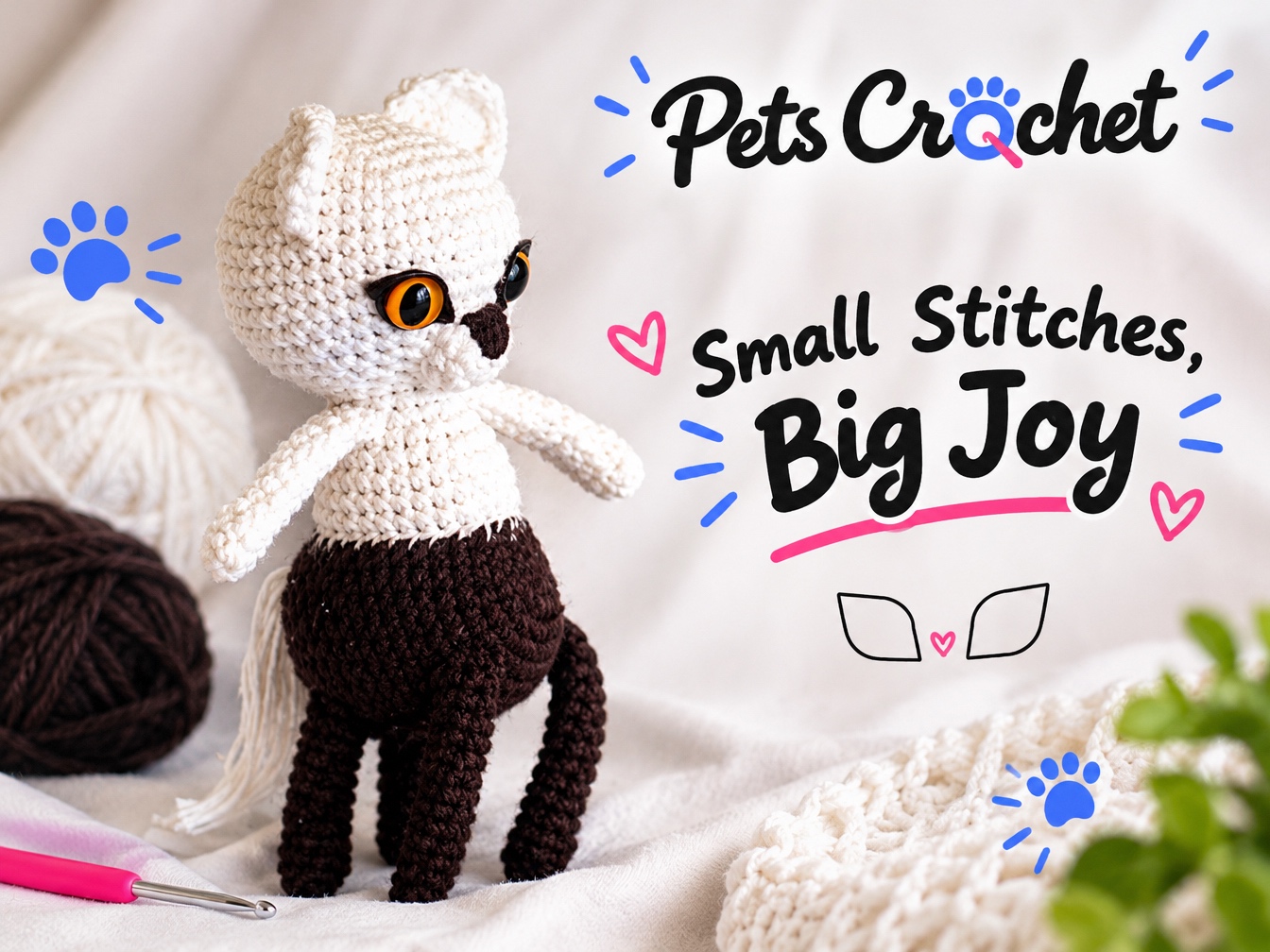
This Sagittarius kitten crochet pattern gives a familiar amigurumi cat an unusual silhouette. A white head and upper torso sit above a black, four-legged lower body, with two little arms and a strand tail completing the centaur-style figure.
The head and torso are the place to begin. They are worked together from the top down, so the round head narrows into the neck before widening again at the base. The free PDF includes all 26 rounds of that connected piece, plus the remaining parts and assembly for the full kitten.
1. Sagittarius Kitten: Head & Torso

The contrast makes the construction easy to read. The head is broad, the neck is narrow, and the torso flares towards its open lower edge. Pointed ears, a small muzzle and golden-coloured eyes give the face its character.
Work the upper piece in a continuous spiral, without joining or turning between rounds. A marker at the first stitch is useful here: the smooth surface can make it surprisingly easy to lose track of where one round ends.
Keep the torso base open
Round 26 finishes at 28 single crochet stitches. That opening is used when the torso is attached to the separate lower body. Closing it as if it were the bottom of an ordinary stuffed cat would change the assembly.
How the head becomes the torso
| Rounds | What changes | Count to check |
|---|---|---|
| 1-7 | The head expands from the starting ring. | 6 to 42 stitches |
| 8-13 | Plain rounds build the head depth. | 42 each round |
| 14-17 | Seven decrease repeats narrow the head. | 35, 28, 21, then 14 |
| 18-20 | A short narrow neck continues below it. | 14 each round |
| 21-26 | The upper torso widens and finishes open. | 21, then 28 |
The decrease rounds deserve a careful count. The head increases begin with six repeats, but the decreases use seven. Carrying the six-repeat habit into Round 14 would leave 36 stitches instead of 35 and shift the rounds that follow.
Fit the eyes and fill the head before access becomes difficult. The instructions do not give a fixed eye round or stitch spacing, so compare the actual eyes, muzzle and finished reference before securing anything.
Yarn, hook and finished size
The pattern calls for worsted-weight yarn in two colours and a 3.75 mm hook. The listed allowance is 120 yards of each colour for the complete figure. That is not a measured yarn requirement for the head and torso alone.
The whole kitten is described as about 7.5 inches tall. There is no separate head-and-torso measurement or numerical gauge. Make a small stuffed swatch in your actual yarn, then check that the fabric contains the filling without stretching open. Keep the two colours compatible in weight and tension so the upper and lower pieces work together.
White and black create the strong contrast in the photo. Another colour pair would need its own sample; changing yarn can alter the proportions as well as the look.
The face and optional felt details
The muzzle is made separately and embroidered with a small triangular nose. Two 15 mm amigurumi eyes are listed, along with optional felt for lashes and ear lining. Check how your particular eyes attach before planning their positions.

The outline is a shape reference, rather than a promise that it will print at the right size for every fitting. Cut a trial pair, check that the felt lies flat and does not cover the visible eye centres, then secure the details carefully.
Embroidered features would change the photographed finish. They can be explored on a sample, but a change of eyes alone does not make the whole design a tested child or pet toy.
What finishes the full figure?
The lower body is a rounded tube worked in the contrast colour. It supports two longer front legs and two shorter back legs. The upper torso attaches on top of its front portion, while the arms sit at the sides of the white torso.
Make matching parts before sewing them on. Baste the legs and torso in position on a level surface, then check the balance from the front and side. The single finished photo does not establish exact hidden seam positions, so the guide describes those placements as a fitting trial.
The tail uses six cut lengths of yarn. Its loose strands are part of the display finish, so choose a spot where real pets cannot reach them. This is a cat-inspired figure for a cat lover, rather than a plaything for a cat.
Questions before you start
Does the PDF stop after the head and torso?
No. The connected upper piece is the focus, but the guide also includes the lower body, ears, muzzle, arms, four legs, tail and assembly. You can follow one download through to the complete figure.
Is the whole kitten worked in one piece?
The head, neck and upper torso are connected. The lower body and smaller parts are made separately and sewn on. This is not a no-sew pattern.
Is Sagittarius Kitten a beginner project?
The pattern is intermediate. It uses familiar single crochet, increases and decreases, but the count changes, small tubes, facial details and assembly need attention.
Are construction photos included?
There is one finished reference photo and a felt outline. The guide adds a clearly labelled count diagram and written construction notes; it does not present them as photographed steps.
Have the guide clarifications been tested?
No new physical sample has been made. The lower-body starting-chain correction, ear-edge placements, feature positioning and joining interpretations are identified as draft details to check on a sample.
Begin with the head count and keep a note beside each completed round. Reaching the 14-stitch neck with the counts intact gives you a clear checkpoint before the torso widens again.